Atherosclerotic plaque G&R
The G&R algorithm is based on the spatial velocity gradient  defined as to satisfy the homogenous stress hypothesis:

Note
One day this algorithm will include several bio-chemo-mechanical interactions.
Exponential integration
See also [8] for the following algorithm details.
The spatial velocity gradient is defined as:

And the deformation gradient can be expressed as:

And computed in terms of exponetial integration:

However, we need  , expressed in the reference configuration (we solve the formulation in the reference config). it can be expressed as:
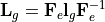
And the exponential integration can be expressed as:
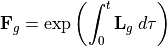
And exprssed in a discrete form as:
