Homogenous stress hypothesis
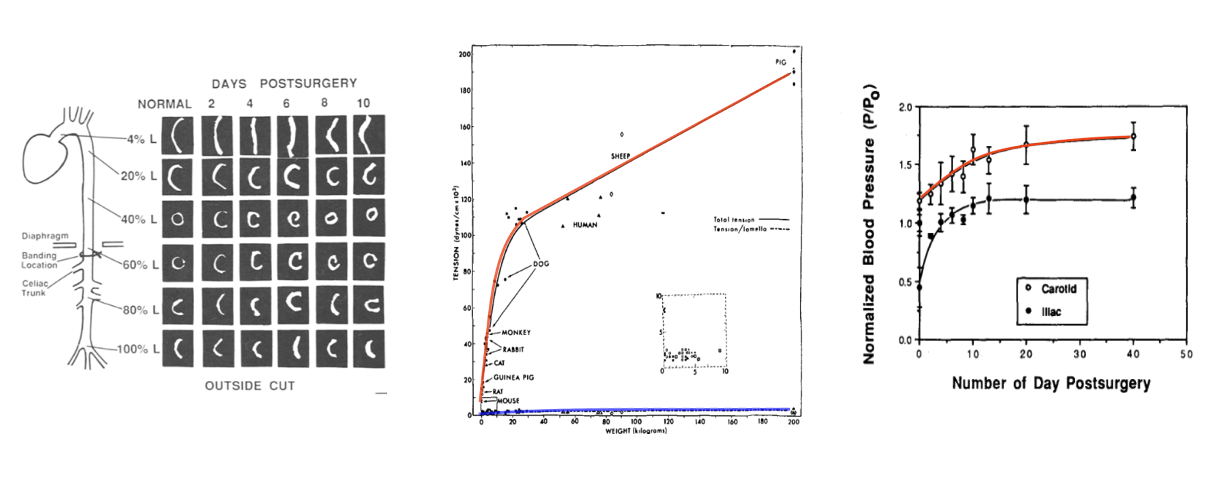
Warning
The following is partially taken from my Master thesis.
Atherosclerotic diseases are multifactorial phenomena related to several chemo-mechanical interactions occurring in a relatively long time. Vascular tissue also shows a continuous remodeling that affects the development of the pathology.
One of the most important remodeling activities present in vascular tissue is related to the stress state associated with the average blood pressure conditions during an heartbeat. For biological tissues, there exists a preferred homostatic stress state maintained by the tissue itself [2]. It is not clear what variable regulates this state however several studies show how stress plays a very important role [10].
Then, depending on the intensity of the external mechanical stimuli, growth and remodeling of the tissues activate in order to maintain a homeostatic tensional state. In fact, the presence of residual stresses and strains within vascular tissues is known for several years and is strongly supported by experimental studies [3, 12].
Residual strain
The stress that exists in an unloaded configuration is called residual stress and, generally, in living tissues it is non-null, although it must be clearly self-balanced. Moreover, the stress and strain state is strongly related to the biological functions of the cells, tissues, or organs. It is a reciprocal interaction between stresses that modulate cell activity inducing growth and remodeling of the vascular tissue that in turn changes the three-dimensional stress and strain state.
The most common approach for residual strains measurements is related to the opening angle. It relies on the idea of using an arterial segment with one or more cuts to relieve the stress. So it is possible to compare the stress-free configuration (the one with cuts) with the closed ring, focusing on the load, strain, and stress necessary to close the configuration. However, there is a general consensus that this approach is not sufficient to characterize the complete three-dimensional stress state in the arterial wall although it could necessary to consider the residual stress state as a fully three-dimensional property of the tissues [5].
A well-established hypothesis is that the main purpose of the residual strain is to contribute to the homogenization of the stress inside the vascular tissue [4]. It is induced across the vascular wall thickness in order to compensate for the effect driven by the inside pressure of the blood. So, a number of interesting approaches are based on the hypothesis of uniform stress distribution across the wall thickness [1].
Hypothesis: homogenous stress theory
The arterial wall could be assumed to evolve to maintain a constant stress gradient across the wall thickness. This is called homogenous stress theory and is in contrast with the more typical assumption of zero initial stress hypothesis. It is related also to the uniform strain theory which hypothesizes that the vascular wall maintains constant the circumferential strain in the cross section during the remodeling process [11], both are based on the growth and remodeling process seen as strongly related to the organism homeostasis.
Experimental evidence shows how the stress state in the vessel is maintained around a determined range. This range is constant across the individual life span and several biological species [13]. Furthermore, it could be altered by pathological state [7]
Generally, the vascular vessel tensional homeostasis leads to a negative stress gradient in the arterial wall with a negative strain on the outside of the vessel in the load-free configuration [1]. So, it is possible to see the growth and remodeling process as an active action acted to minimize the stress differences in the structure. In fact, a structure with a more homogeneous stress state is, in general, safer from an engineering viewpoint than a structure with a higher stress peak.
The aforementioned hypotheses are generally used to investigate the growth and remodeling processes of healthy vascular tissue, often in structures characterized by regular geometries and a single material. This is far different from real clinical cases that require accounting for complicated geometries and multiple material descriptions. Whilst vascular tissue generally shows biochemical homeostasis, for other pathological tissues present in the atherosclerotic region, such as the lipid-rich necrotic core or the calcifications, it is not possible to grow and remodel [6]. However, they play an active role in determining the stress state that acts on the vascular tissue processes affecting the development of high-stress areas as well as vessel portions partially cleared from loads. Hence, it is possible to hypothesize that structures that are not able to adapt towards a more homogenous stress state, show a higher risk of rupture due to the occurrence of high stresses.
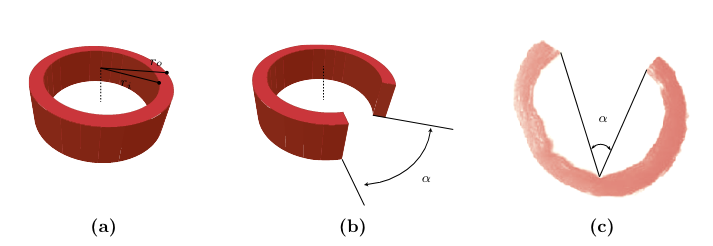
One of the way to represent the opening angle α. Whole ring geometry with internal and external radii(a); Cutted ring geometry (b); Opening of a common carotid artery ring showing the relasing of residual stresses (c) [5].
Project goal
The goal of this project is to develop a computational tool for the stress analysis of patient-specific carotid structures with large atherosclerotic regions. The general aim is to improve the accuracy of emph{in silico` strategies for risk evaluation and plaque rupture estimation. This is aimed by enriching traditional simulation approaches via a growth and remodeling formulation that employs a multi-material description. Adopting a growth strategy based on the homogenous stress hypothesis, residual strains and stresses for vascular vessels are computed in realistic clinical scenarios. Accordingly, their impact in determining the biomechanical state of the vessel are accounted for and evaluated on four different patient-specific case studies with different pathological conditions.