myPostAuxialiars.m
This pakcage includes the solving routines withing the post-processing auxialiries to read and insert information in each element.
A load history is used to drive the boundary pressure and a growth history is used to modulate the G&R algorithm.
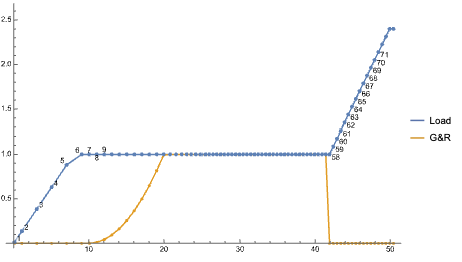
The functions are defined into the my_post_auxiliaries.m package with respect to the simulation time as argument:
 drive the pressure linear increase up to MAP (it stops after the growth is activated)
 drive the growth linear increase up to 1 once the growth is activated
 drive the linear growth increse from MAP to systolic pressure, after the growth is computed
Warning
The following description is partially AI generated, it might be incomplete or incorrect.
- checkWallElement[elementMaterialRatios_]()
Checks if each element in the given list is a wall element.
- Parameters:
elementMaterialRatios (List of Associations) – A list of material ratios for elements.
- Returns:
A list of boolean values indicating whether each element is a wall element.
- Return type:
List of Booleans
Usage Example:
checkWallElement[elementMaterialRatios]
- λp[t_]()
Pressure loading function based on time.
- Parameters:
t (Number) – The current time step.
- Returns:
The pressure loading value at time t.
- Return type:
Number
Usage Example:
λp[time]
- λp2[t_]()
Alternative pressure loading function considering growth conditions.
- Parameters:
t (Number) – The current time step.
- Returns:
The pressure loading value considering growth at time t.
- Return type:
Number
Usage Example:
λp2[time]
- λg[t_, growthEnded_]()
Growth loading function based on time and growth status.
- Parameters:
t (Number) – The current time step.
growthEnded (Boolean) – Boolean indicating whether growth has ended.
- Returns:
The growth loading value at time t.
- Return type:
Number
Usage Example:
λg[time, growthEnded]
- ΔtMax[t_]()
Determines the maximum time step increment based on current simulation time.
- Parameters:
t (Number) – The current time step.
- Returns:
The maximum allowed time step increment.
- Return type:
Number
Usage Example:
ΔtMax[time]
- breakingCall[input1_, step3_]()
Checks if the simulation should be stopped based on the input conditions.
- Parameters:
input1 (Boolean) – A condition to check.
step3 (Number) – A step number to check.
- Returns:
True if the simulation should stop, otherwise False.
- Return type:
Boolean
Usage Example:
breakingCall[condition, stepNumber]
- postProcess[t_]()
Updates the growth and pressure loading functions after each simulation step.
- Parameters:
t (Number) – The current time step.
- Returns:
None
Usage Example:
postProcess[time]
- showSolutionParams()
Displays the solution parameters in a table format.
- Returns:
A table of solution parameters.
- Return type:
TableForm
Usage Example:
showSolutionParams[]